

An Coimisiún Pleanála – Case reference: PA07.324113
Gluaiseacht supports Athenry Peaker Plant Concern Group
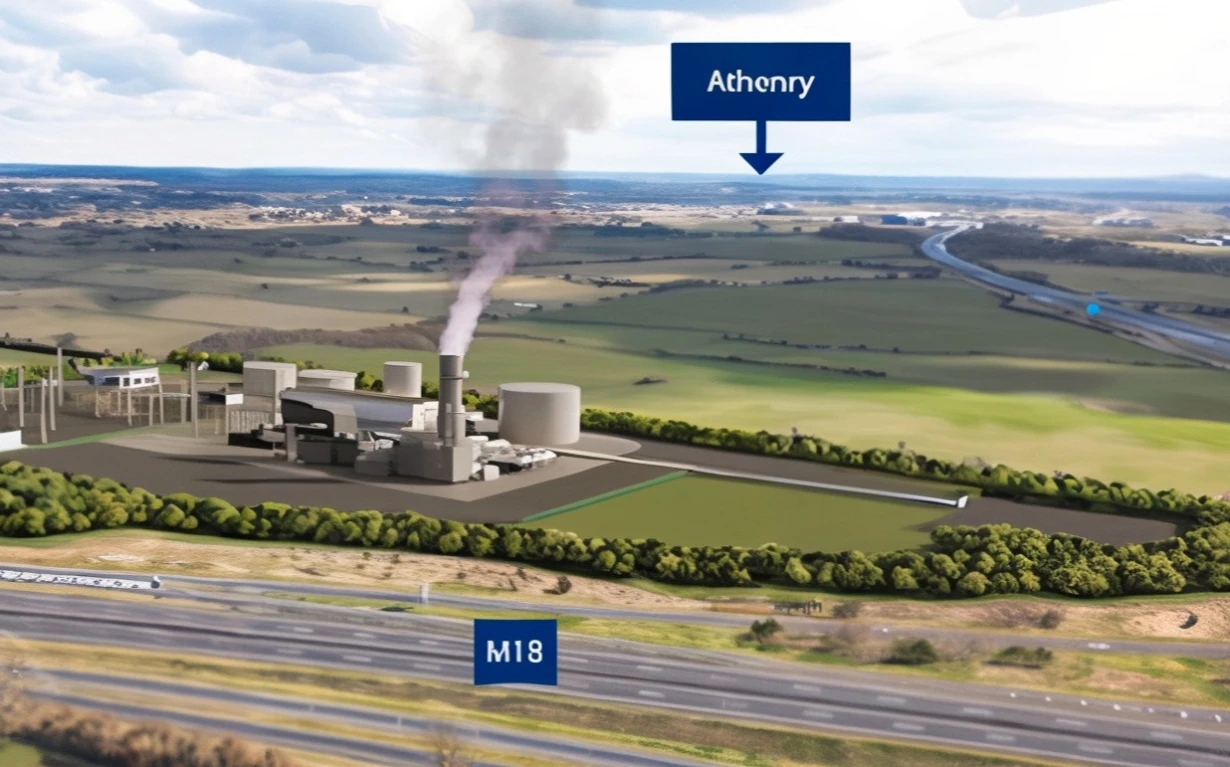
Gluaiseacht is working with the Athenry Peaker Plant Concern Group, an independent community group of local residents who are fighting against the approval of the Cashla Peaker Plant, a Bord Gáis Energy project.
In April Gluaiseacht made a submission to An Coimisiún Pleanála objecting to this proposed energy infrastructure (see below).
The proposed development includes an Open Cycle Gas Turbine and a diesel plant with a capacity of 334 MW — a fossil fuel infrastructure that, according to the community group, poses significant risks to:
 The health of local residents
 The natural environment of the area
 The historical and cultural heritage of Athenry
This is not an isolated case. Projects like this are part of an energy model that Ireland urgently needs to move beyond. While households across the country are paying some of the highest electricity prices in Europe, developments like this — operating for only a handful of hours each year at a disproportionate cost to the public — continue to be pushed forward.
 We will keeping an eye on how this process continues and follow the next steps necessary once An Coimisiún Pleanála rules on these submissions.
Applicant: Bord Gais Energy
20/04/26
A chara,
I refer to the above planning application and wish to make the following objection in relation to the proposed development.
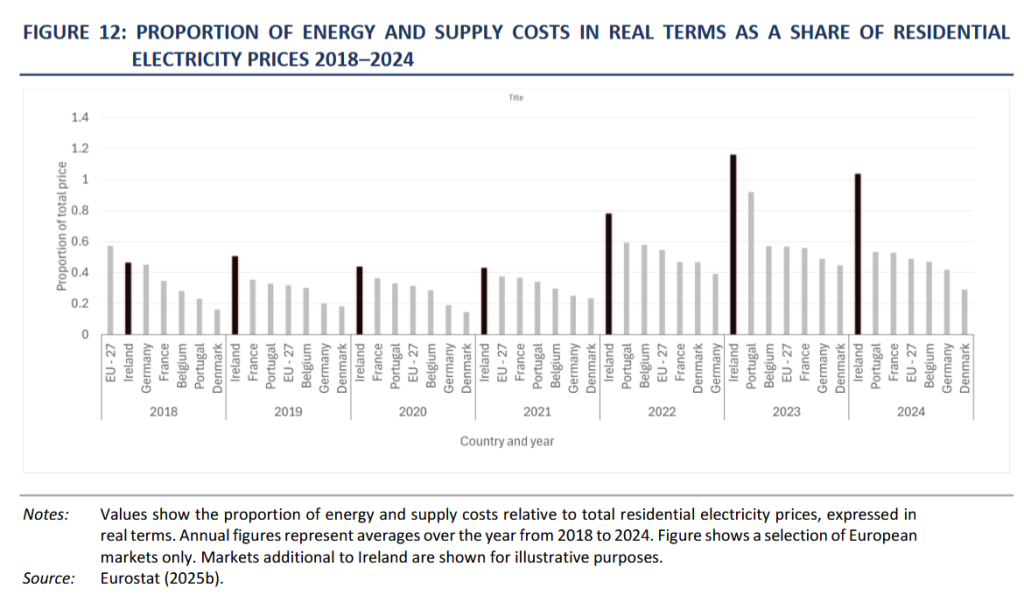
This application reflects a broader pattern that has emerged within the Irish electricity system in recent years, the effects of which are evident in persistently high electricity costs. For example, Figure 1 (from a recent ESRI report) illustrates that Ireland is significantly out of step with electricity prices across Europe, with “Energy and Supply” costs accounting for over 100% of residential electricity prices in 2023.
The development proposed in this application is stated to operate for approximately 100 hours per year. The project has secured a 10 year contract valued at approximately €560 million to provide 262MW of capacity when required.
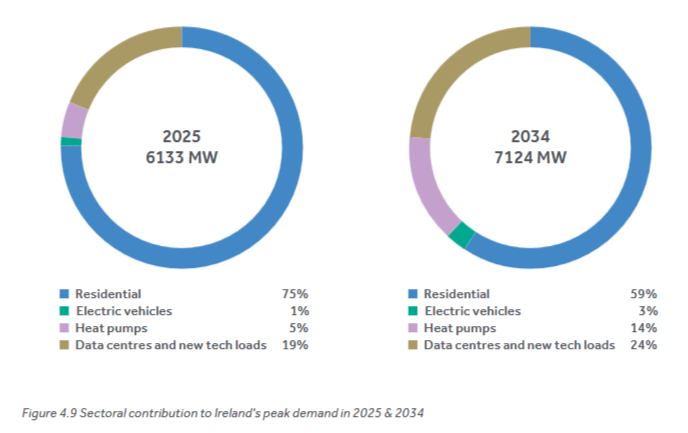
Based on EirGrid projections of peak electricity demand of 7,124MW by 2034, this equates to a relatively small proportion of overall system capacity (circa 3.7%), at a very substantial cost.
Based on EirGrid projections of peak electricity demand of 7,124MW by 2034, this equates to €560,680 for every hour of operation to provide just 3.7% of the projected max peak electricity demand.
In this context, it is submitted that the proposed development raises serious questions as to whether it represents an efficient or sustainable approach to meeting Ireland’s future energy needs. In particular, it is difficult to reconcile such a development with the requirement to achieve proper planning and sustainable development under the Planning and Development Act 2000.
If permitted, the project would represent a continuation of a model of energy provision that is neither environmentally sustainable, nor aligned with broader social and economic objectives.
We therefore urge that permission be refused.
Electricity Price Costs
The application says that “In September 2024, Bord Gáis Energy entered Ireland’s Single Electricity Market Operator (SEMO) T-4 capacity auction for the 2027/2028 delivery year and secured a 10-year capacity contract from October 2028 to September 2038 for the proposed development.”
It seems from the Capacity Auction Results that Bord Gáis Energy was awarded a capacity of 262MW at a Capacity Payment Price of €214,000 per MW. This would mean for a 10 year contract they have been awarded €0.56 billion or €56million a year for this peaker plant.
Using the applicant’s figure of operation at only 100 hours a year this would work out that Bord Gáis Energy would be getting €560,680 for every hour of operation. This is insanity.
In Eirgrid’s “Resource Adequacy Assessment 2025–2034” report is estimating that the 2034 peak demand will be 7124MW.
It seems from the Capacity Auction Results that Bord Gáis Energy was awarded a capacity of 262MW at a Capacity Payment Price of €214,000 per MW. This would mean for a 10 year contract they have been awarded €0.56 billion or €56million a year for this peaker plant.
Ireland already has one of the highest energy and electricity costs in the EU and this State LNG facility will drive it even higher.
According to the most recent EuroStat statistics, excluding taxes and levies, Ireland has the most expensive electricity prices. Ireland is now €0.0658 per KWh more expensive than the next dearest electricity price country (Luxembourg) and €0.1413 per KWh more expensive than the EU average.
Among the reasons for this are the following
-
- Ireland has been running the most expensive gas capacity auctions for a number of years now. Research by Aurora Research commissioned by BeyondFossilFuels, into 6 different European capacity markets found that Ireland is paying the highest of any, up to 147,580€/MW compared to the next highest of 86,206€/MW in Great Britain
-
- The connected fact of 6.2GW of new gas fired power plants either have been consented to in recent years or with in train planning applications
-
- Temporary Emergency Generation costs due to the electricity grid being under so much pressure in recent years.
-
- All the cost in recent years for the additional network costs. For example the CRU recently approved an investment package of up to €18.9 bn in Ireland’s national electricity grid and network for the regulatory period 2026-2030.
-
- And now that the Government plans to build a State Led LNG import terminal. CEPA have reportedly said that the LNG terminal will cost €900million to build, a figure that doesn’t include the operational costs of paying all the LNG carriers that will be transporting the fracked gas from the US.
Climate Emissions Modelling
The modelling of climate emissions used in the application is totally inadequate.
The application has modelled the climate emissions for 100 hours use of the power plant saying that the annual emissions are only “between 21,299 and 21,779 tCO2e”. The air quality modelled for continuous use ( 24 hours per day, 365 days per year) so why has this unrealistic climate emissions modelling being used.
In Eirgrid’s “Resource Adequacy Assessment 2025–2034 they stated “Since 2016, EirGrid and SONI via the GCS have warned of an increasing tightness between
supply and demand. There is no question that the current outlook, based on the best
information available, remains challenging. It is likely that in the coming years the system will experience a number of system alerts and the TSOs will need to work proactively to mitigate the risk of a more serious impact across Ireland and Northern Ireland.”
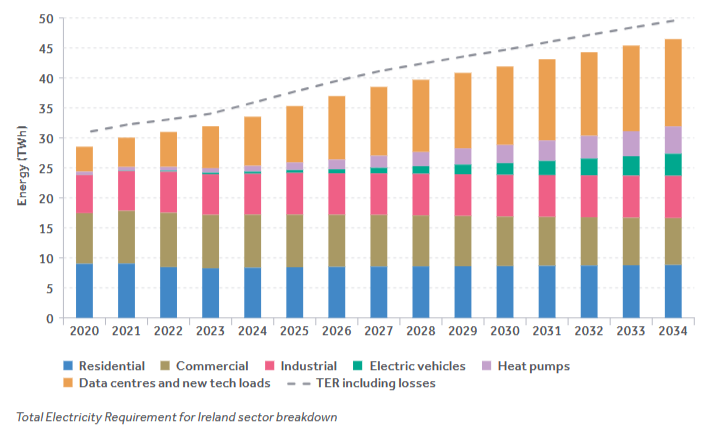
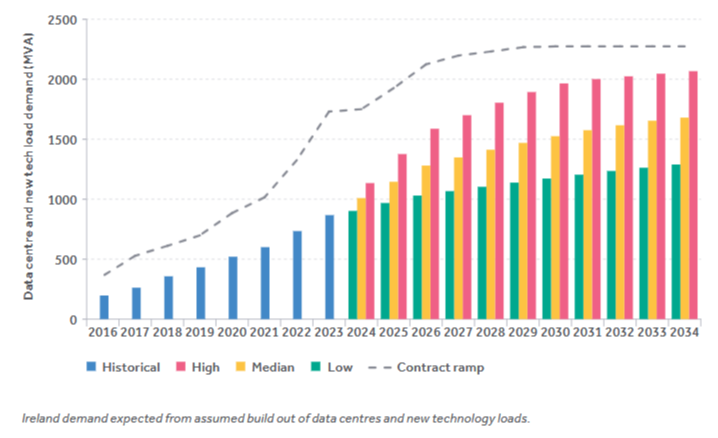
The applicant hasn’t justified why it has only chose to model emissions for 100 hours but given the demand profile that Eirgrid are predicting over the next decade, the figures used by the applicant are not realistic. This can be seen below from the images taken from the latest Resource Adequacy Assessment. Data Centre demand is due to rise to over 30% of electricity use by 2030.
The obvious solution to prevent greenhouse gas and air pollutant emissions from the burning of fossil fuels is to stop burning them – we need to rapidly reduce our energy demand back to within the capacity of our renewable resources. An overall reduction in energy use is the only viable basis for tackling climate change. This means we need strategies of so-called ‘energy descent’ and ‘de-growth economics’. The strategies of using economic growth and interest rates as a means to provide for the necessities of life, need to be disposed of and replaced with strategies that don’t mine non-renewable resources.
This proposed development does the direct opposite to this and so should be rejected out of hand.
Gluaiseacht
PDF available here